Actions
What a rule does when it fires — assign, label, reply, close or call your own systems.
Actions are the THEN part of a rule. One rule can perform several, in order.
Routing Actions
| Action | Does |
|---|---|
| Assign User | Gives the ticket to a specific person |
| Assign Team | Gives it to a team — anyone in it can pick it up |
| Close Chat | Closes the ticket |
Prefer Assign Team over Assign User in automation. Team routing keeps working when someone is on leave; individual routing quietly piles up in an absent person's queue.
Tagging Actions
| Action | Does |
|---|---|
| Attach Label | Adds a label to the contact |
| Assign Stage | Puts the contact on a column of your pipeline board, opening a lead if they are not on it yet |
| Assign Lifecycle (legacy) | Moves the contact to a lifecycle stage. Superseded by Assign Stage |
These make later filtering and reporting possible. A rule that labels every refund enquiry costs nothing and makes "how many refund requests last month?" answerable.
Assign Lifecycle (legacy) is offered only on a rule that already uses it, so existing rules keep running and can still be saved. New rules get Assign Stage instead — see Leads that open themselves.
Messaging Actions
| Action | Sends |
|---|---|
| Send Message | A plain message |
| Send Template | An approved template |
| Send Flow | A WhatsApp flow |
| Send Web Survey | A web form |
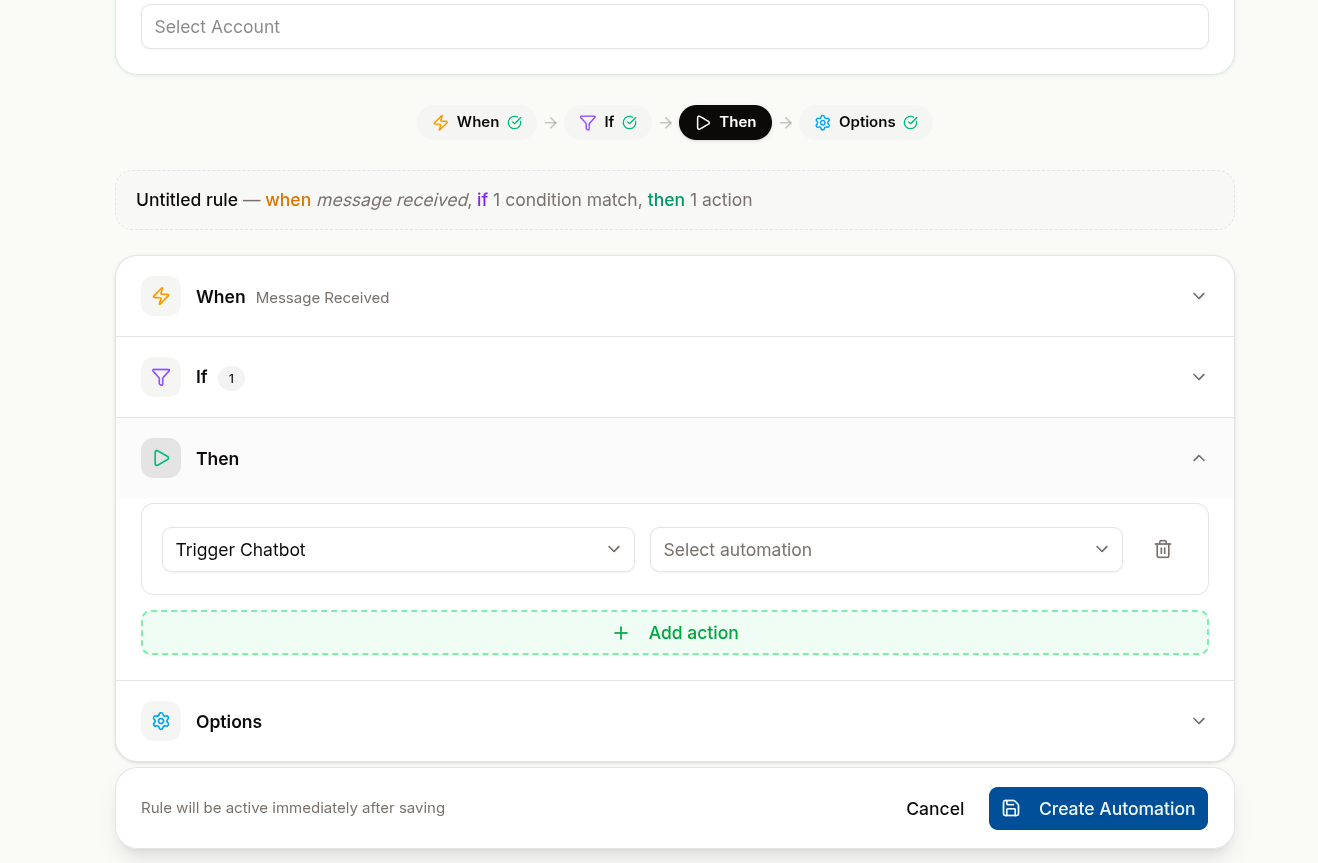
| Trigger Chatbot | Hands the conversation to a chatbot |
Outside WhatsApp's 24-hour window, only Send Template will actually deliver. A Send Message action on a stale conversation fails silently — check Message Analytics if replies are not arriving.
Integration Actions
| Action | Does |
|---|---|
| Call External API | Sends the event to a URL you control |
Use this to notify your own systems — create a record in your CRM, trigger a fulfilment job, post to a team channel.
See Integrations for webhook setup and payloads.
Combining Actions
Actions run in order, so a single rule can do a complete piece of work:
When a message is received · if the body contains "refund" · then attach the Refund label → assign the Billing team → send the acknowledgement template
Keeping Automations Safe
- Start narrow. One keyword, one account, then widen.
- Avoid loops. A rule that sends a message on message-received can re-trigger itself if the direction is not filtered.
- Do not auto-close on a customer message. Closing what someone just wrote in about is the fastest way to lose them.
- Name your rules properly. "Untitled rule" is unmaintainable six months later.
- Review quarterly. Rules outlive the campaigns that justified them.