Automation
Conditions
Narrow a trigger down so the rule fires only when it should.
Conditions are the IF part of a rule. They are optional — a rule with none fires on every
occurrence of its trigger.
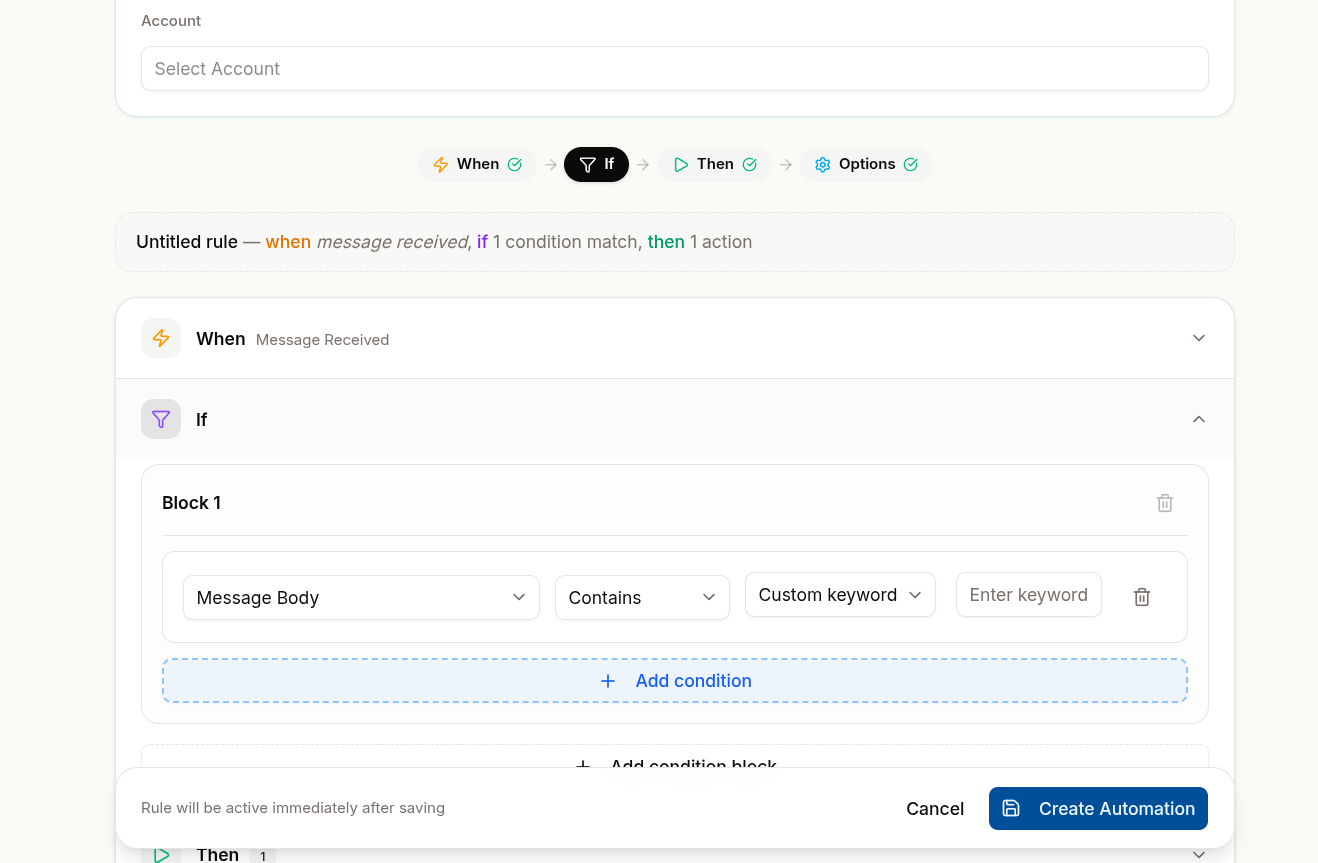
What You Can Test
| Field | Checks |
|---|---|
| Message Body | The text of the message |
| Message Direction | Whether it came in or went out |
| Thread Subject | The ticket's title |
| Contact Email | The contact's email address |
| Contact Label | Labels on the contact |
| Contact Group | Groups the contact belongs to |
| Contact Lifecycle | The contact's lifecycle stage |
Operators
| Operator | True when |
|---|---|
| Equals | The value matches exactly |
| Contains | The value appears anywhere |
| Starts With | The value begins with it |
| Ends With | The value ends with it |
| Greater Than | Numerically larger |
| Less Than | Numerically smaller |
Contains is the right default for message text. Equals on a message body almost never matches — real customers do not send exactly one word.
Match All vs Match Any
| Setting | Meaning |
|---|---|
| Match all | Every condition must be true (AND) |
| Match any | At least one must be true (OR) |
Match any is how you catch the several ways people phrase the same thing — refund, money back, return.
Match all is how you narrow — a message containing "refund" and a contact labelled VIP.
Writing Conditions That Actually Fire
- Test lowercase and common misspellings — customers do not proofread
- Prefer a few broad keywords over many exact ones
- Watch for accidental matches — a rule on "no" will fire constantly
- Check the direction if a rule is looping; an outgoing message can re-trigger a badly scoped rule