Responses & Results
Reading individual responses, analysing the whole set, and exporting the data.
Three tabs cover what came back: Responses for individual submissions, Analytics for the picture across all of them, and Team Analytics to compare the same results between teams.
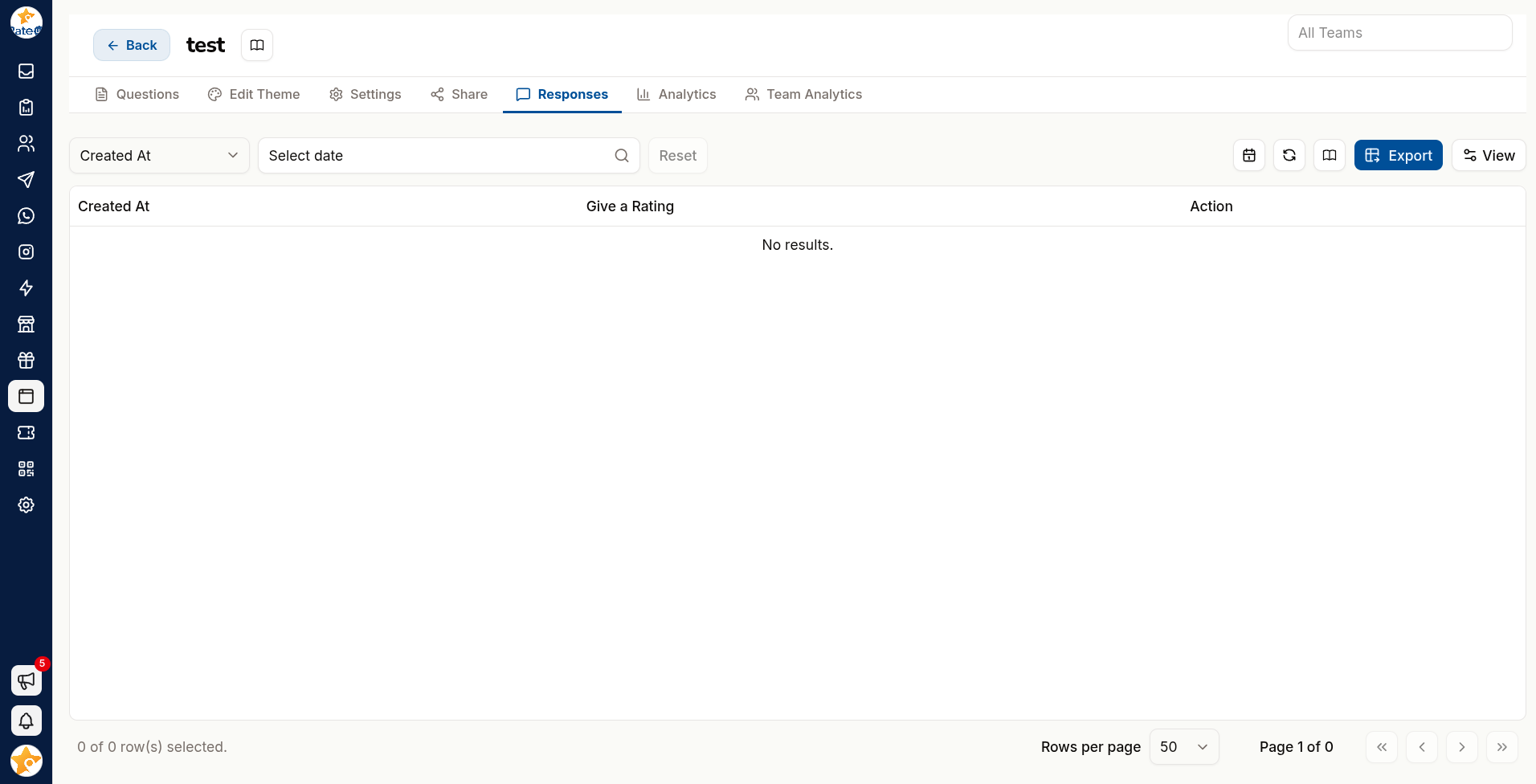
Responses
Every individual submission, with its answers, timestamp and any URL tags it carried.
Read these when you need the detail: a specific complaint, a lead's contact details, the wording someone used.
Analytics
Happiness Index
An overall satisfaction score across responses, from Poor through Okay, Good, Great and Excellent.
NPS breakdown
Net Promoter Score responses split three ways:
| Group | Score | Meaning |
|---|---|---|
| Promoters | 9–10 | Will recommend you |
| Passives | 7–8 | Satisfied but not enthusiastic |
| Detractors | 0–6 | Unhappy, and may say so |
Passives are the opportunity. Promoters already advocate and detractors are a rescue job; passives are the group closest to becoming promoters if you find out what is missing. Use a logic jump to ask them specifically.
Per-question charts
Each question gets its own visualisation — distributions for choice and rating questions, response listings for free text.
Team Analytics
The same result set, compared between teams — useful when several branches or departments run the same form and you need to know which is ahead.
AI Summaries
| Feature | Produces |
|---|---|
| Generate Summary by AI | A written summary of the responses |
| Generate Team wise summary | The same, broken down by team |
| Large Text Summary | A digest of long free-text answers |
This is most valuable on free text, where hundreds of paragraphs are otherwise unreadable.
Treat a summary as a starting point, not a finding. Read a sample of the raw responses before acting — a summary smooths over exactly the sharp, specific complaint you most needed to see.
Exporting
| Format | Use |
|---|---|
| Excel / CSV | Analysis elsewhere |
| Export to PDF | A shareable report |
| Google Sheet | Live sync to a spreadsheet |
Exports contain whatever respondents told you, including contact details. Treat them as personal data.
Filter before exporting — by team, date or response content — rather than exporting everything and trimming later.
Acting on Results
A survey nobody acts on trains customers not to answer the next one.
| Signal | Action |
|---|---|
| Detractor response | Follow up personally — see Automations |
| Repeated complaint about one thing | Fix the thing; the survey has done its job |
| Promoters | Ask for a Google review or a testimonial |
| Falling response rate | The form is too long, or you are asking too often |
Related Pages
- Automations — review routing and following up
- Testimonials
- Sharing