Working a Lead
Adding a lead, the details drawer, next activities, notes, and closing or reopening it.
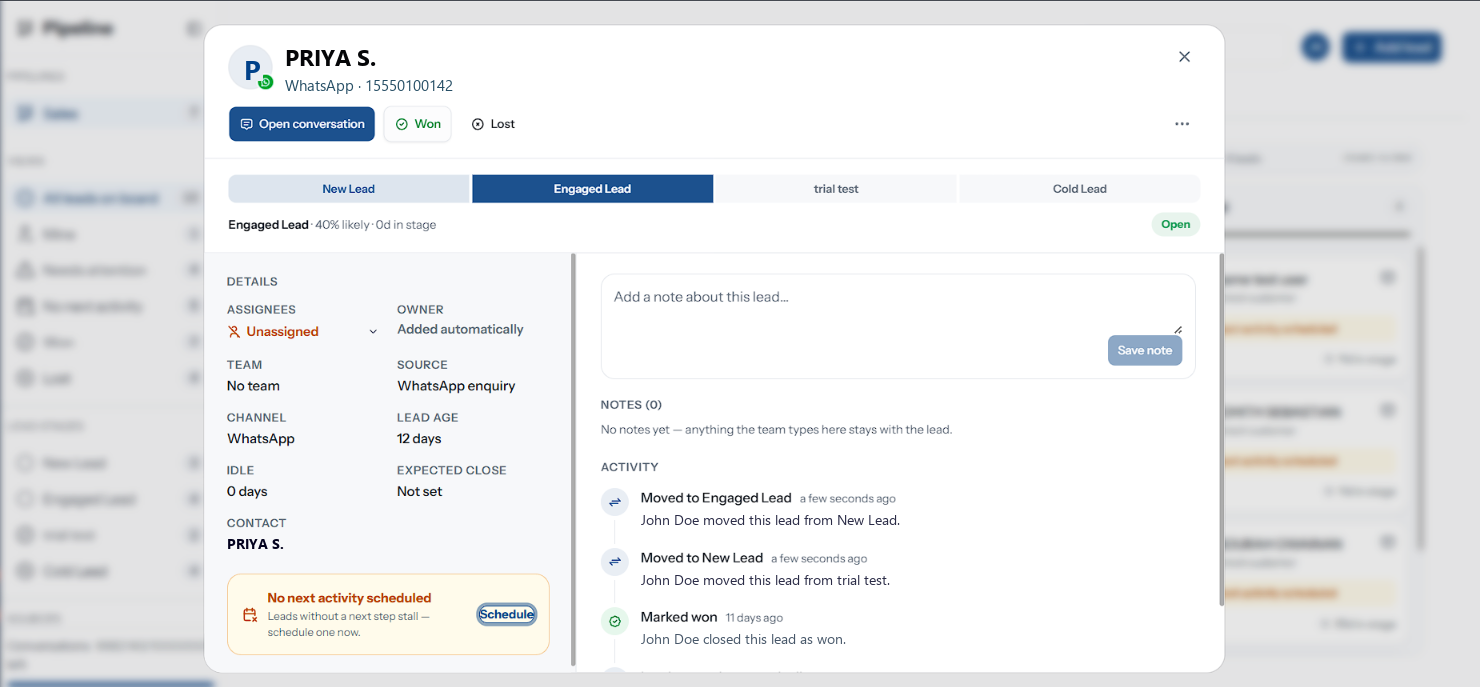
Everything about one lead lives in a drawer that slides in from the right. Open it by clicking a card on the Board, or a row in the List.
Adding a Lead
Add lead in the header opens on no particular column; the + on a column header opens on that one.
Pick the Customer, either way round. Choose from contacts searches your existing contacts by name, phone or email; Enter details manually takes a Contact name, an optional Business / company and an optional WhatsApp number for somebody who is not in your contacts yet.
Pick the Stage it starts in.
Pick the Source — WhatsApp enquiry, Instagram DM, Messenger, Web survey, Referral program, Loyalty program or Added manually. The first three also set the channel the lead is reachable on.
Optionally tap the Assignees you want on it, then Add lead.
The lead copies the contact's name, phone and email so a card can render without a second lookup, but it is the contact link that matters — it is what makes Open conversation work.
A number typed in manually is looked up as you finish it, and the line under the field says what will happen with it:
| It says | Meaning |
|---|---|
| Nobody has this number yet — it will be added to your contacts | A new contact is created with the lead |
| {name} already has this number — the lead will be linked to them | Use their details links the lead to that contact instead of duplicating them |
| Linked to {name} — the lead opens their conversation in Inbox | Already linked. Unlink breaks it |
A name on its own is enough to save. That lead has no contact behind it, so its card carries the broken-link icon and Open conversation stays disabled until somebody gives it a number. A number that is typed has to be dialable — "That number doesn't look right." refuses anything else, since the lead carries it verbatim.
Choosing a closing column says so: "{stage} is a closing column — the lead opens already closed." That is occasionally what you want, for a deal you are recording after the fact.
The Header
| Button | Does |
|---|---|
| Open conversation | Jumps to this contact in the Inbox. Disabled on a lead with no contact |
| Won | Opens the close confirmation. Disabled on a lead already won |
| Lost | The same, asking for a reason. Disabled on a lead already lost |
| ⋯ → Reopen lead | Puts a closed lead back on the board. Disabled while it is open |
| ⋯ → Delete lead | Removes the lead outright |
Delete lead asks nothing. The lead, its notes, its activities and its whole timeline go immediately, and the drawer closes. If what you want is to record that it did not work out, use Lost — a lost lead stays on the board and still counts in your insights.
Under the buttons sits the stage stepper: every column in order, the current one highlighted, with its win probability and how many days the lead has been in it. Clicking another step moves the lead — including onto a closing column, which asks the same way a drag does.
The Next Activity
The single most useful field on a lead: what happens next, and when.
Schedule opens the panel. Type what has to happen — "Follow up on the quote".
Pick a Type: Call, Message, Meeting, Document or To-do. The type only chooses the icon that shows on the card.
Set a Due date and time, and optionally who it is assigned to. Then Schedule.
Once scheduled, the panel offers Mark done. An overdue activity turns red on the card and in the list. A lead with nothing scheduled shows No next activity scheduled in amber, and appears under the sidebar's No next activity view.
Leads without a next step stall. The No next activity count is the one number on this screen you can act on immediately — every lead in it is a decision nobody has made.
Details
| Field | Notes |
|---|---|
| Assignees | Everyone working the lead. Pick from the people on the board's teams; Unassign everyone clears it |
| Owner | Whoever opened it. Fixed, and shown as Added automatically for a lead a rule opened |
| Team | The team it belongs to, or No team |
| Source and Channel | How it arrived, and where the customer is reachable |
| Lead age | Days since it was created |
| Idle | Days since anything happened. Reads "{n} days — stalled" once past the stage's window |
| Expected close | Feeds the Forecast. Not set puts it in the unscheduled bucket |
| Contact | The linked contact, or Not linked |
Labels
Labels are the board's own, defined per pipeline, and are separate from contact labels. The drawer's Add button puts an existing label on the lead, and the chips also show on its board card.
A board with no labels reads "This pipeline has no labels yet — add them in pipeline settings" — but the current build has no label editor in pipeline settings, and the pipeline is not part of the external API either. Until an editor ships there is no way to create one, so the picker will stay empty. Nothing else on the lead depends on labels.
Timeline and Notes
Timeline is the automatic record — created, moved, assignees changed, won, lost, reopened, note added, activity scheduled and completed. Each entry names who did it, or says "Added by automation" when a rule did.
Notes is what your team writes down. A note is attributed and timestamped, and can be deleted by anyone who can open the lead.
Notes count as activity, so leaving one resets the idle clock and clears a needs attention flag. That is intended — someone has looked at it — but it does mean a lead can be kept out of the stalled list without moving forward.
Closing a Lead
Closing happens three ways, and all three end in the same confirmation: Won or Lost in the drawer, the stage stepper, or dragging the card onto a closing column.
| Outcome | What it asks |
|---|---|
| Won | Confirmation only. "The lead moves to the won column and stops counting as open." |
| Lost | A Lost reason, picked from the board's list — and it is required when the board has any |
Both accept an optional closing note, which is kept on the timeline.
The lost reason is the only input the "why do we lose deals" side of reporting ever gets. A board with no lost reasons configured lets a loss through without one, and that loss can never be attributed afterwards — add them in Settings before your team starts closing.
A closed lead stays on the board in its closing column, stops counting as open, and can be put back with Reopen lead.
Troubleshooting
| Symptom | Cause | Fix |
|---|---|---|
| Open conversation is greyed out | The lead has no linked contact | It was created without one; raise a new lead from the contact |
| Nobody appears in the assignee picker | Nobody is on the board's teams yet | Add a team in Settings |
| Mark lost stays disabled | The board has lost reasons but none is selected | Pick one |
| The lead has no labels to choose | The board has none defined | Add them in pipeline settings |