Managing Contacts
Add, find, view, edit, message, import, export and delete the people in your database — one at a time or in bulk.
Contacts → All Contacts is the full list of everyone in your database. This page covers getting people in, finding them again, working on them in bulk, and keeping the data clean.
Where Contacts Come From
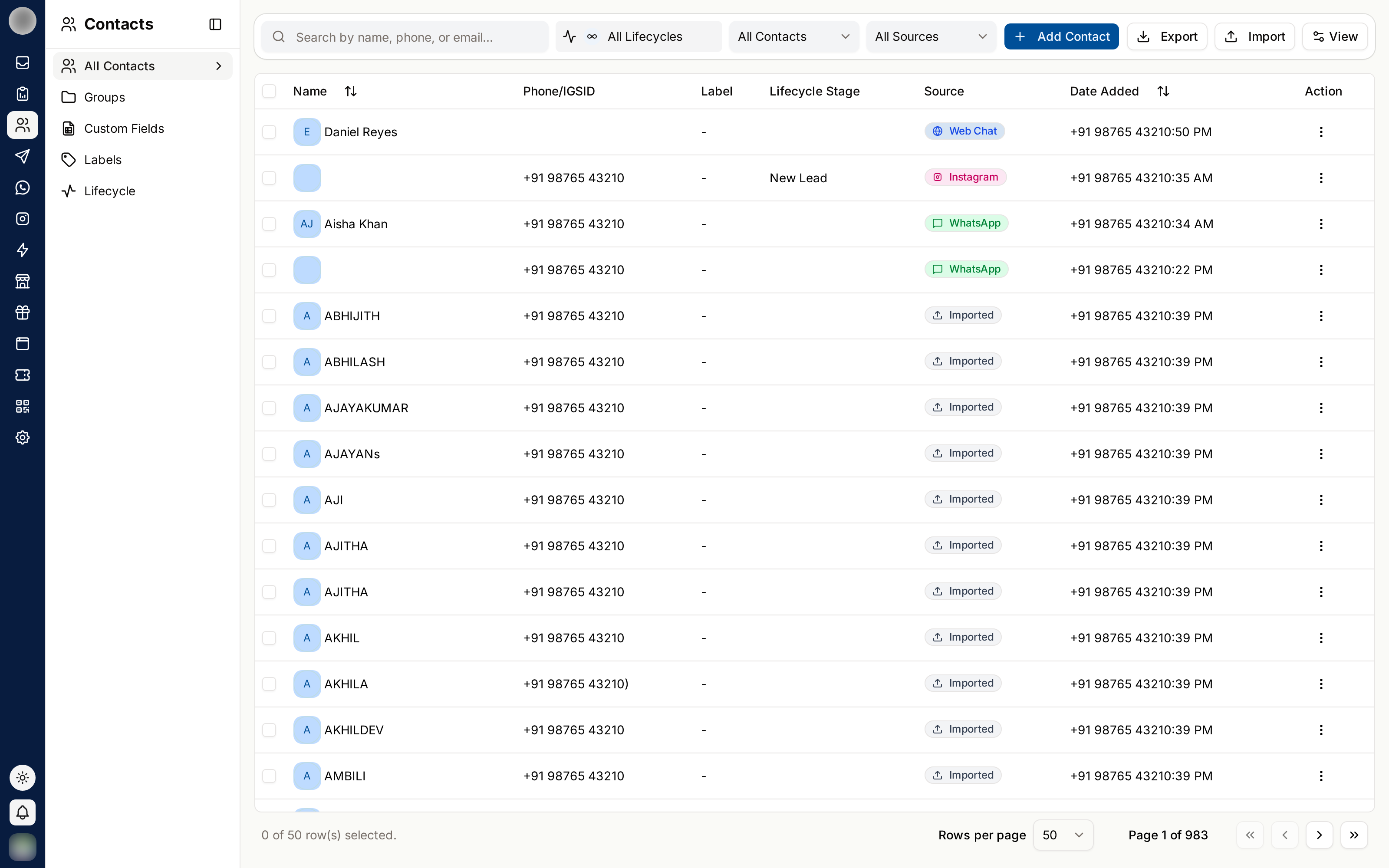
Every contact carries a source, shown as a badge on the list and in their details:
| Source badge | How they arrived |
|---|---|
| They messaged one of your WhatsApp numbers | |
| They messaged or commented on your Instagram account | |
| Web Chat | They wrote in through your website chat |
| Manual | Someone on your team added them by hand |
| Imported | They came in through a file import |
| Loyalty Customer | They joined your loyalty programme |
Anyone who messages you becomes a contact automatically — you never have to add inbound customers yourself.
The Contacts Table
By default the table shows Name, Phone/IGSID, Label, Source and Date Added. More columns are available from the View menu at the top right of the toolbar:
| Column | Shows |
|---|---|
| Name | The contact's name — click it to open their details |
| Phone/IGSID | Phone number, or Instagram ID for Instagram contacts |
| Status | Active, or Blocked if you have blocked them on WhatsApp |
| Other | Extra information, such as a location |
| Label | Their labels |
| Lead stage | Their column on your pipeline board. Organisations without a board see Lifecycle Stage instead, if lifecycle display is on |
| Each custom field | One column per custom field |
| Source | Where they came from — see above |
| Consent | Granted or Denied — whether they may receive templates and campaigns |
| Date Added | When the contact was created |
| Last Contact | When they last messaged you |
Sort by Name, Date Added or Last Contact by clicking the column header. The list is paged; pick how many rows to show at the foot of the table.
Search and Filter
The toolbar holds one search box and three filters. They combine, so Label: VIP plus Source: Instagram shows only VIPs who came in through Instagram.
| Control | Narrows by |
|---|---|
| Search by name, phone, or email... | Text anywhere in the name, phone number or email. A leading + is ignored, so paste numbers as they are |
| Stage | A column of your pipeline board. Without a board, this is a Lifecycle filter instead |
| Label | All Contacts, one label, or a status: Active or Blocked |
| Source | All Sources, WhatsApp, Instagram, Web, Manual or Imported |
Reset appears once a filter is active and clears them.
There is no filter for groups or custom fields on this page. To see who is in a group, open the group itself under Groups.
Add a Contact
Click Add Contact.
Fill in Full Name and Phone Number — both are required, and the phone number must be valid with its country code. "Invalid phone number" means it is not.
Optionally add:
- Labels — pick any number
- Lead stage — puts them straight onto your pipeline board (shown only if your board has columns)
- Assignee — the team members responsible for them
- Group — any number of groups
- notes
- A value for each custom field
Click Save. If something is wrong, a "Fix the following before saving:" list tells you what.
You can also add a contact from the Inbox, with New Contact in the Inbox toolbar.
Adding a contact does not open a messaging window. If they have never written to you, your first message must be an approved template.
Act on One Contact
Every row has a ⋮ menu at the end:
| Option | What it does |
|---|---|
| View Details | Opens the contact's details — the same as clicking their name |
| Edit | Opens Edit Contact with every field from Add a Contact |
| Send Message | Sends a quick text message without leaving the page — see below |
| Open in Inbox | Jumps to this contact's conversation in the Inbox |
| Delete contact | Deletes them — see Deleting Contacts |
View a contact's details
Click a contact's name (or ⋮ → View Details) to open everything RateUp knows about them in one place.
| Section | Contains |
|---|---|
| Header | Name and phone, with badges for source, inbox status, lifecycle, No consent, Blocked and Spam where they apply |
| Contact | Phone, Email, WhatsApp name, Location, Date of birth, Consent, Added, External ID |
| Activity | Last received, Last sent, Assigned to, Lead stage, Lead owner, and how many campaigns they have been in |
| Labels | Their labels, or "No labels" |
| Custom fields | Every custom field with a value — hidden fields are left out |
| Loyalty | Programme, Tier, Points (available and lifetime) and Referral code — only for loyalty members |
| Groups | Every group they are in. Click ✕ to remove them from one, or Add to group to add them to another |
| Notes | Free-text notes about the customer. Click the pencil to edit, then Save |
Rows with nothing to show are left out, so a sparse contact gets a short dialog. Hover a phone number, email, ID or referral code to reveal a copy button.
Send Message at the bottom of the dialog opens the quick-message box.
Send a quick message
Choose ⋮ → Send Message, or Send Message in the details dialog.
Pick the channel under Select Channel — WhatsApp or Instagram — and the Account to send from.
Type the Message and send it.
This sends free text, which WhatsApp and Instagram only accept within 24 hours of the customer's last message. For anyone who has not written recently, it will fail — send a template from the Inbox instead.
Bulk Actions
Tick the checkbox on each row you want — or the checkbox in the header to take the whole page. A bar appears showing "N Selected" with four actions:
| Action | What it does |
|---|---|
| Add to Group | Adds everyone selected to one group |
| Apply Label | Opens Apply Labels to Contacts — pick one or more labels and click Apply |
| Update lead stage | Puts everyone on one column of your pipeline board, opening a lead for anyone not on it. Organisations without the Pipeline feature see Update Lifecycle Stage |
| Delete | Deletes everyone selected, after a confirmation |
The header checkbox selects the current page only. To act on more people, raise the rows per page first.
Import Contacts From a File
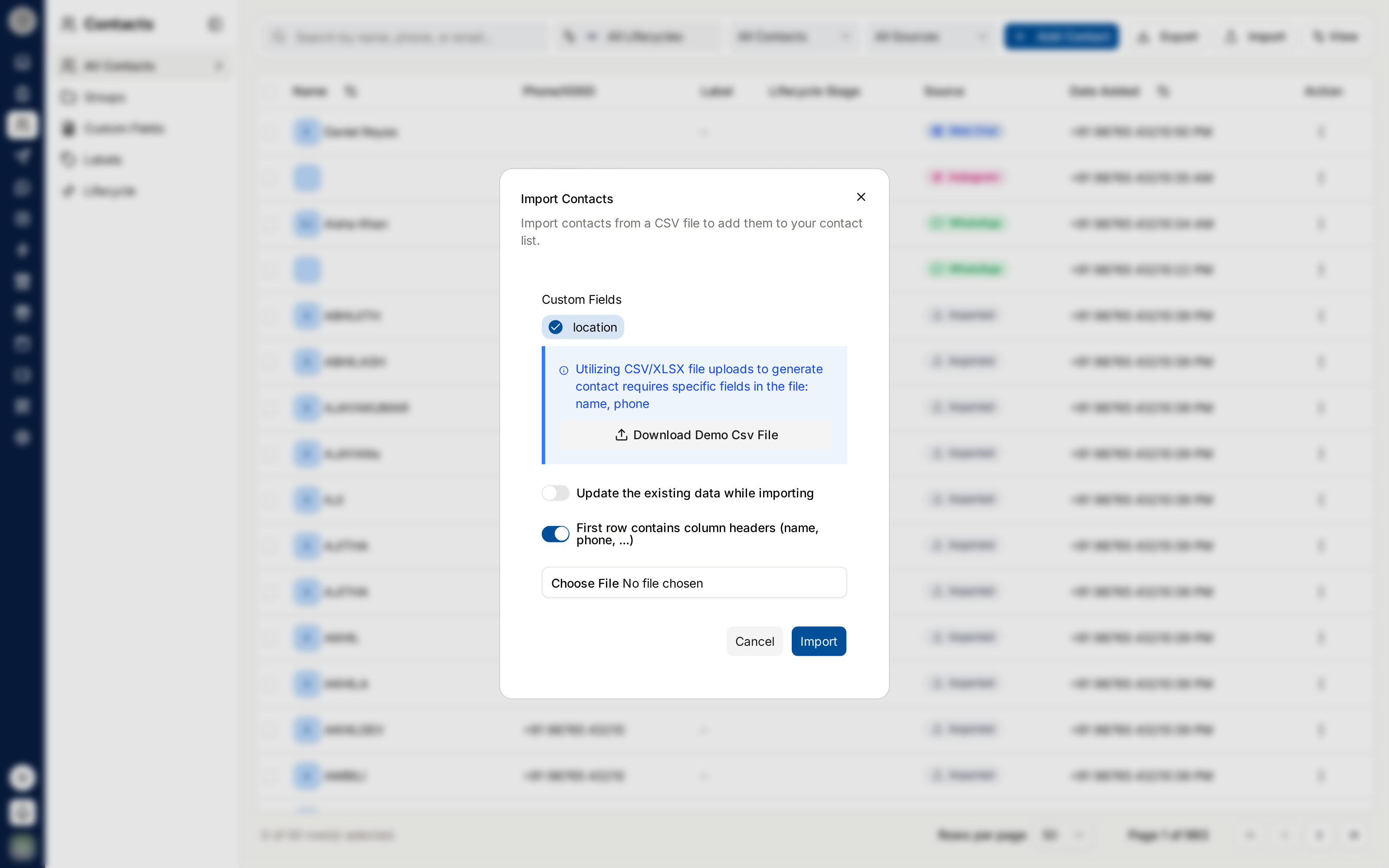
Click Import. The Import Contacts dialog opens.
Click Download Demo Csv File and lay your data out the same way. The file needs a name and a phone column.
Under Custom Fields, tick the custom fields your file contains. Each one's column must be headed with that field's Field ID — shown on the Custom Fields page.
Set the two switches:
- Update the existing data while importing — see below
- First row contains column headers (name, phone, ...) — on by default. Turn it off for a file with no header row. The columns must then run name, phone, then the ticked custom fields in order
Choose the file — CSV, XLSX or ODS — and click Import.
Imported contacts get the source Imported.
Existing contacts
A phone number can only belong to one contact, so an import never creates duplicates:
| Update the existing data while importing | A phone number already in your contacts is… |
|---|---|
| Off (default) | Skipped — the existing contact is left exactly as it is |
| On | Updated with the file's name and any custom-field values it has |
A blank custom-field cell never overwrites a value that is already there.
Rows that are rejected
A row is rejected if its name is missing or its phone number is missing or invalid. The rest still import, and a Failed contact import list shows each rejected row with the reason — for example "phone is missing" or "…: Invalid phone number".
Phone numbers must include the country code — 447700900123, not 07700900123. Numbers
spreadsheets have turned into scientific notation (4.477E+11) are converted back for you.
What an import can set
An import sets name, phone and custom fields only. Email, labels, groups and stages are not read from the file — apply them afterwards with bulk actions. To import straight into a group, import from the group's Add Members dialog instead — see Groups.
Only import people who have agreed to hear from you. Messaging a list that never opted in lowers your WhatsApp quality rating, and that is far harder to repair than a slow month of campaigns.
Export Contacts
Use the View menu to show the columns you want in the file.
Click Export and choose Download as Excel or Download as OpenDocument (ODS).
The export contains every contact in your organisation, newest first — your search and filters do not narrow it. It includes these visible columns: name, phone, status, other, source, consent, date added and custom fields. The Label, Lead stage and Last Contact columns come out empty.
Exports contain personal data. Treat the file accordingly and delete it when you are done.
Deleting Contacts
Delete one contact from ⋮ → Delete contact, or several with the Delete bulk action.
Deleting a contact cannot be undone, and it reaches further than RateUp:
- Every conversation and message with them is deleted, along with their group memberships, labels and campaign history
- If you have Zoho CRM or Bigin connected, the matching contact is deleted there too
- Zapier receives a contact deleted event
Their pipeline lead is kept but no longer linked to anyone. If someone just asks not to be contacted, withdraw their consent instead — deletion is for data-removal requests.
Keeping the Database Clean
- Import carefully; most bad data arrives in bulk
- Keep country codes on every phone number
- Review contacts with repeated message failures — see Message Analytics
- Agree naming conventions for labels before everyone invents their own
Related Pages
- Groups
- Labels
- Custom Fields
- Pipeline — the board Lead stage writes to
- Campaigns