Private Notes & @Mentions
Discuss a ticket internally, pull colleagues in with @mentions, and manage the mentions addressed to you.
Private notes let your team talk about a ticket without the customer seeing any of it. They live on the ticket, are visible only to your team, and are never delivered to WhatsApp, Instagram or any other channel.
Message vs Private Note
The composer has two tabs, and they behave differently:
| Message | Private Note | |
|---|---|---|
| Goes to | The customer | Your team only |
| Colour | Blue | Amber |
| Character limit | 1024 | None |
| @mentions | No | Yes |
| Appears in thread as | A normal message | Centred, with a padlock |
Write a Private Note
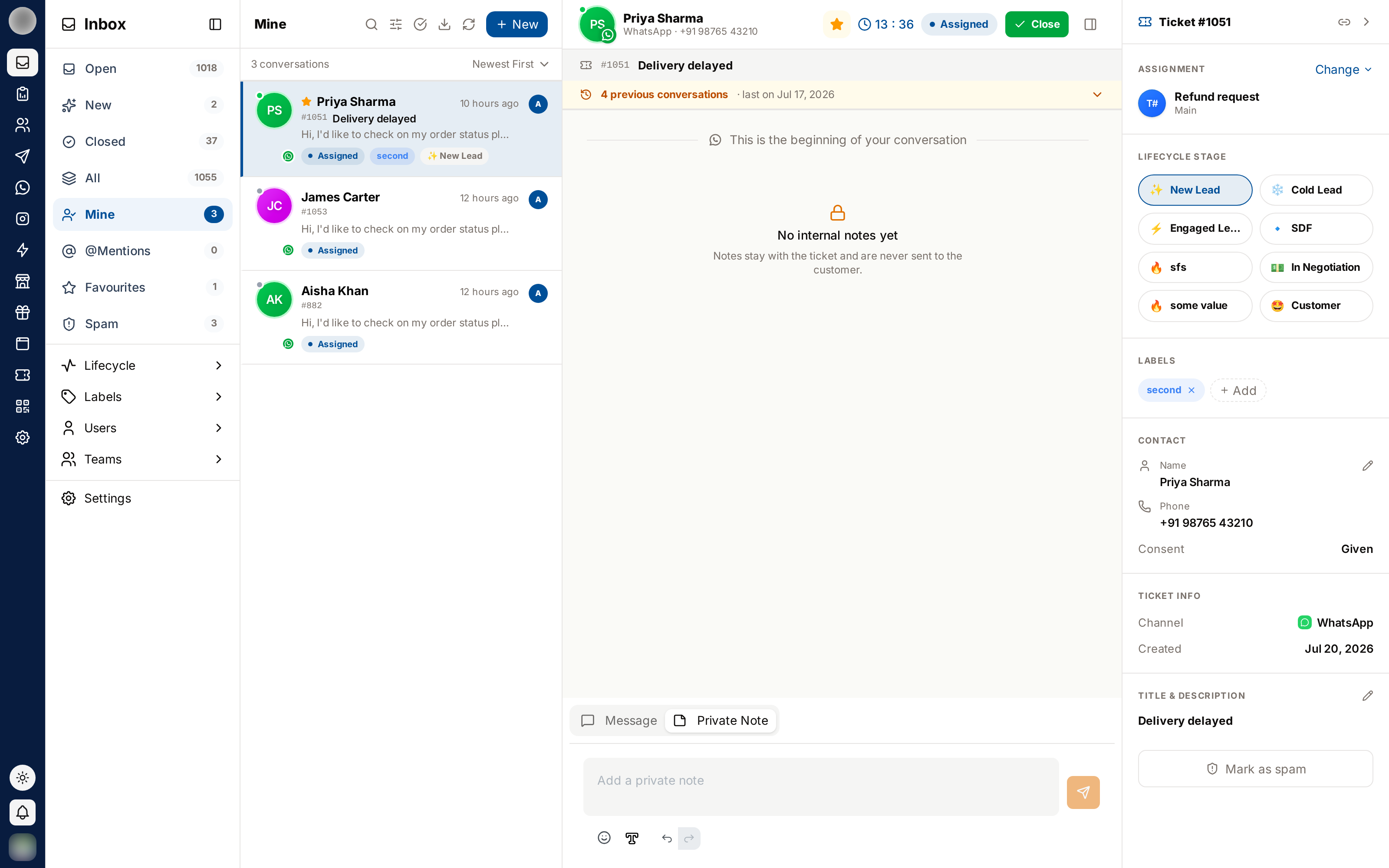
Open the ticket and click the Private Note tab.
Type your note in Add a private note. The composer turns amber to signal that this is internal.
Use the emoji picker and Format Message (T) for bold, italic, strikethrough, code, quotes and lists — handy for a structured handover.
Click Send.
The note is added to the thread immediately, labelled Internal note with your name and the time.
The Notes-Only View
While the Private Note tab is selected, the thread above shows internal notes only.
This turns the internal discussion into its own readable surface, instead of something you scroll past customer messages to find.
Switch back to Message to see the full conversation again. Opening a different ticket always starts on the customer conversation.
This is the fastest way to catch up on a ticket someone handed to you: open it, click Private Note, and read the internal thread top to bottom.
Mention a Colleague
In the Private Note tab, type @.
A list of your organisation's members appears. Keep typing to narrow it, or use the arrow keys.
Press Enter or click a name to insert the mention. It appears highlighted in the note.
Finish the note and click Send.
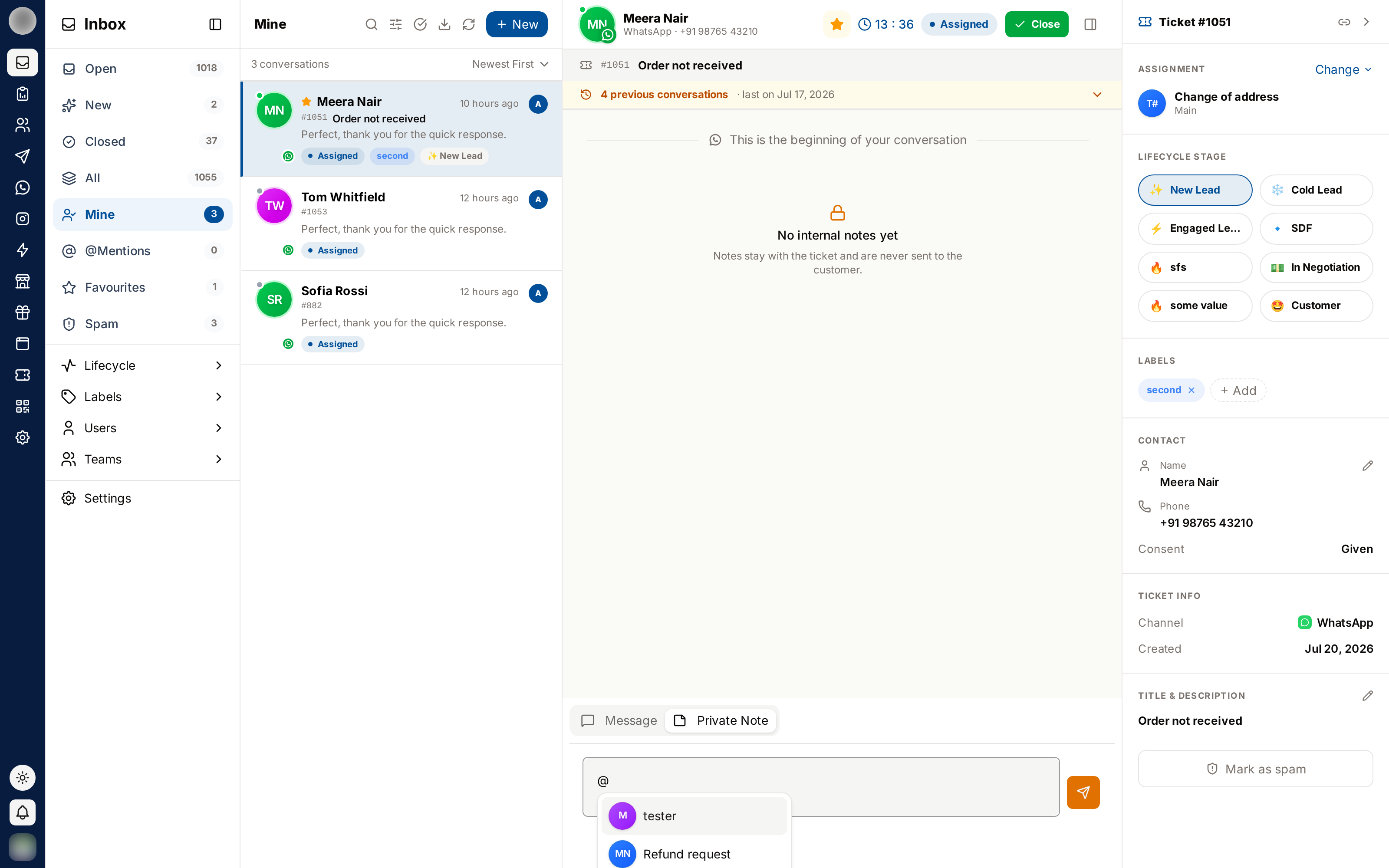
You can mention anyone in your organisation, not just members of your own team. Mention several people in one note if the question concerns all of them.
What the Mentioned Person Sees
When you are mentioned:
- The ticket appears in your @Mentions view
- The @Mentions count in the sidebar goes up
- The ticket row shows an @ Mention chip — with a number if you were mentioned more than once
- An @ button appears in that ticket's chat header
Mentions are personal: you only see mentions addressed to you.
Clearing a Mention
Opening or reading a mentioned ticket does not clear the mention. It stays until you dismiss it deliberately, so it cannot disappear because you glanced at the row.
Open the ticket from @Mentions.
Do whatever was asked — usually a reply in a private note.
Click the @ button in the chat header, next to the star.
The ticket leaves @Mentions and the sidebar count goes down.
Clearing affects you only. The note stays on the ticket, and colleagues mentioned in the same note keep their own mention until they clear it.
What to Use Notes For
| Situation | Note to write |
|---|---|
| Handover | What has been done, what is outstanding, what you promised the customer |
| Escalation | Why it is being escalated and what decision you need — mention the decision-maker |
| Context | Anything you learned that is not in the messages (a phone call, a system check) |
| Decisions | Why you offered the refund, why the exception was approved |
Avoid using notes for anything the customer should be told — switch to Message for that.
Frequently Asked
Best Practices
- Write the handover note before reassigning, not after
- Mention people instead of messaging them outside RateUp — the context stays on the ticket
- Clear your mentions once handled, so @Mentions stays a real to-do list
- Keep notes factual; they are part of the permanent ticket record