Inbox Settings
Configure teams, channels, labels, tags, quick replies and auto-close automation for your Inbox.
Inbox Settings is where admins configure how the Inbox behaves for everyone — who handles conversations, how they are classified, and what agents send.
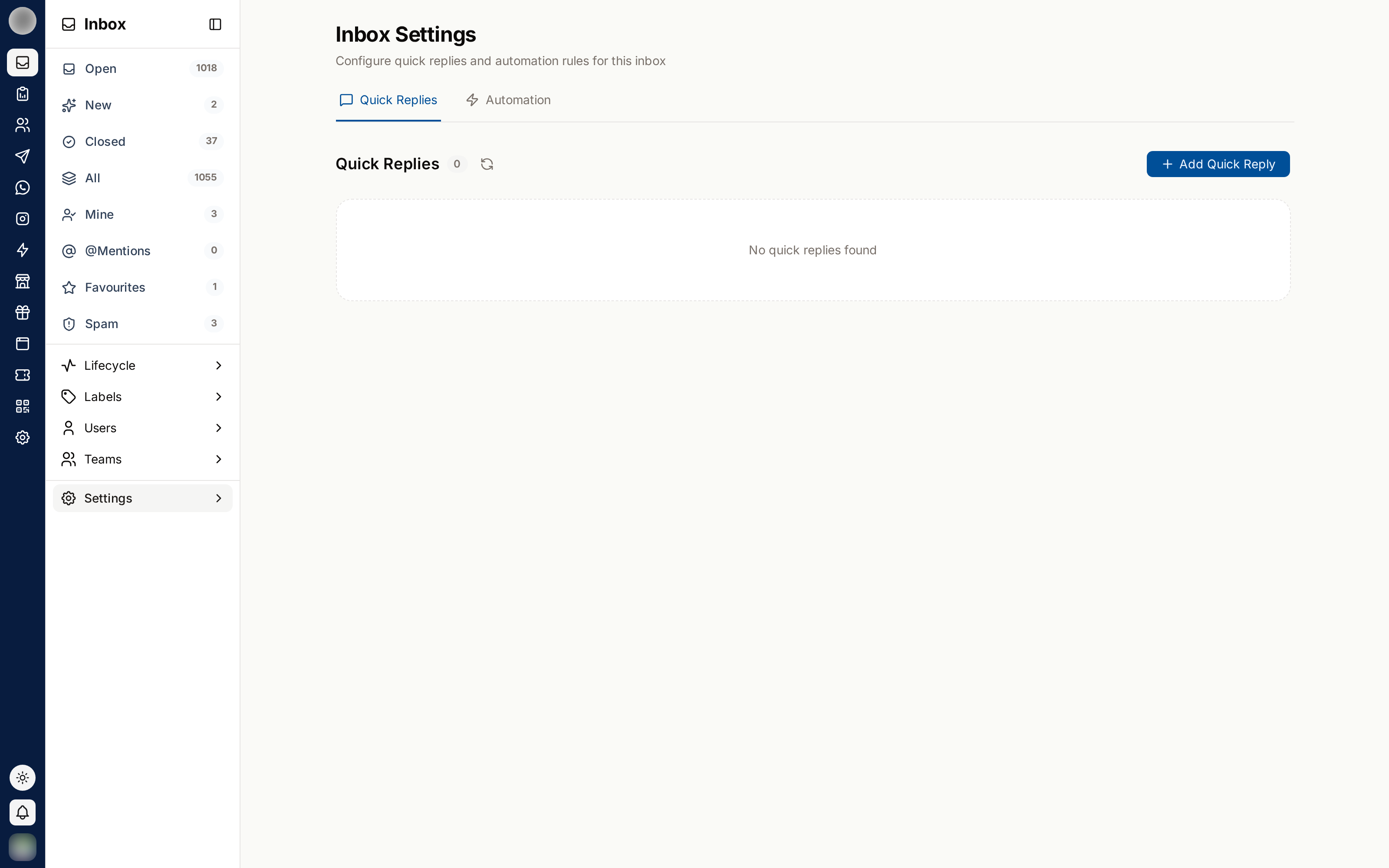
Open it from Inbox → Settings in the sidebar. It has six tabs, in the order work flows through them.
| Tab | What it covers |
|---|---|
| Teams | The teams conversations can be assigned to, and who is on each. Managed on Teams |
| Channels | The accounts this inbox receives on, each marked Connected or Disconnected. Managed on Channels |
| Contact labels | Labels that stay on the customer — see Conversation Tags |
| Conversation tags | Tags that describe a single ticket — see Conversation Tags |
| Quick replies | Saved answers agents insert in the composer |
| Automation | Auto-close rules for tickets that go quiet |
Teams and Channels are read-only summaries here: each carries a Manage teams / Manage channels link through to the Settings page that owns it. They exist so you can see, without leaving the Inbox, who can be assigned work and whether a channel has dropped.
These settings apply to the whole organisation. Changing them affects every agent's Inbox immediately.
Quick Replies
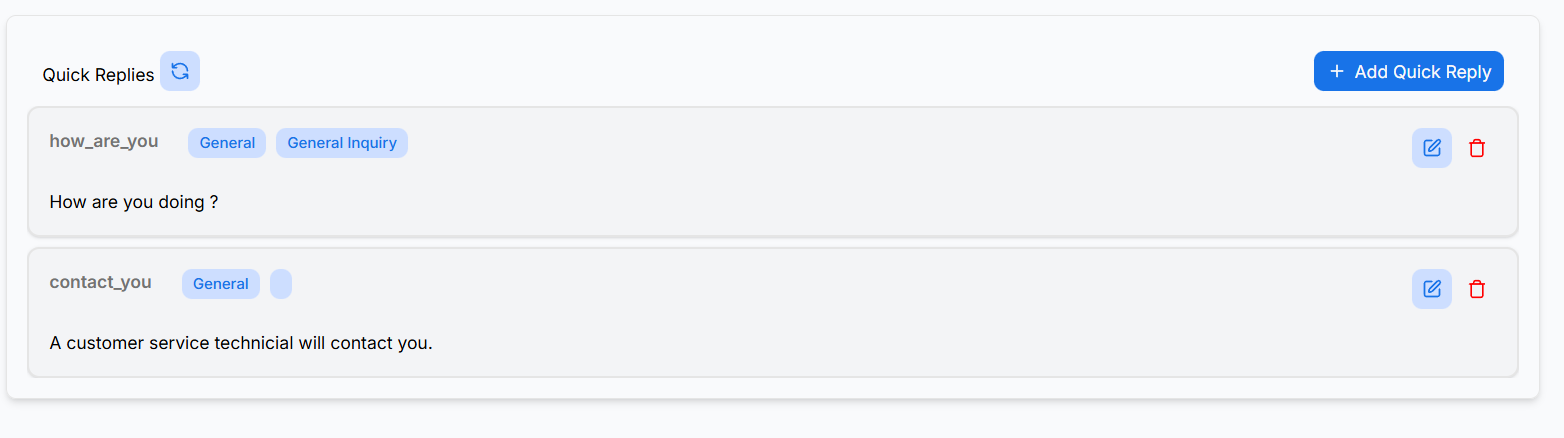
Quick replies are saved answers agents insert instead of retyping the same thing all day.
Agents reach them by clicking the lightning button in the composer, or by typing / in the
message box.
Add a quick reply
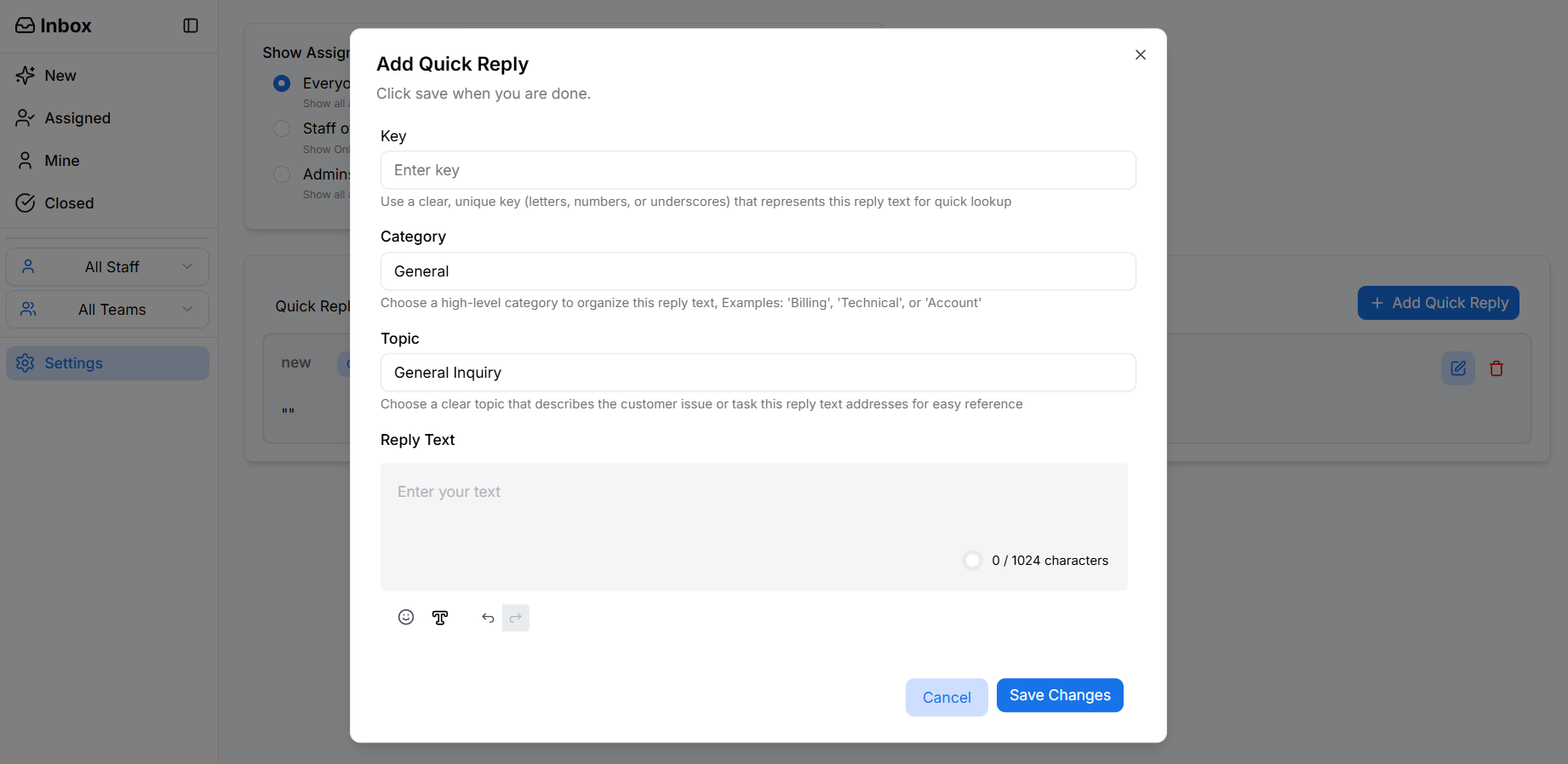
Open the Quick Replies tab and click Add Quick Reply.
Enter a key — a short, unique handle agents will type after /. Keep it memorable:
refund-policy beats qr-14.
Choose a category — a high-level grouping such as Billing, Technical or General.
Choose a topic for more specific context.
Write the reply text, then click Save Changes.
The reply is available in every conversation straight away.
Manage quick replies
From the list you can edit and delete replies, and organise them by category and topic. Changes apply instantly across the Inbox.
Writing good quick replies
- Keep them short — agents will edit them before sending anyway
- Leave the greeting out, so agents can personalise the opening line
- Cover the questions you answer daily, not the rare ones
- Review them quarterly; outdated policies in a quick reply spread fast
- Remember customer messages cap at 1024 characters
Automation: Auto-Close Rules
Tickets that go quiet forever are noise. Auto-close rules end them for you.
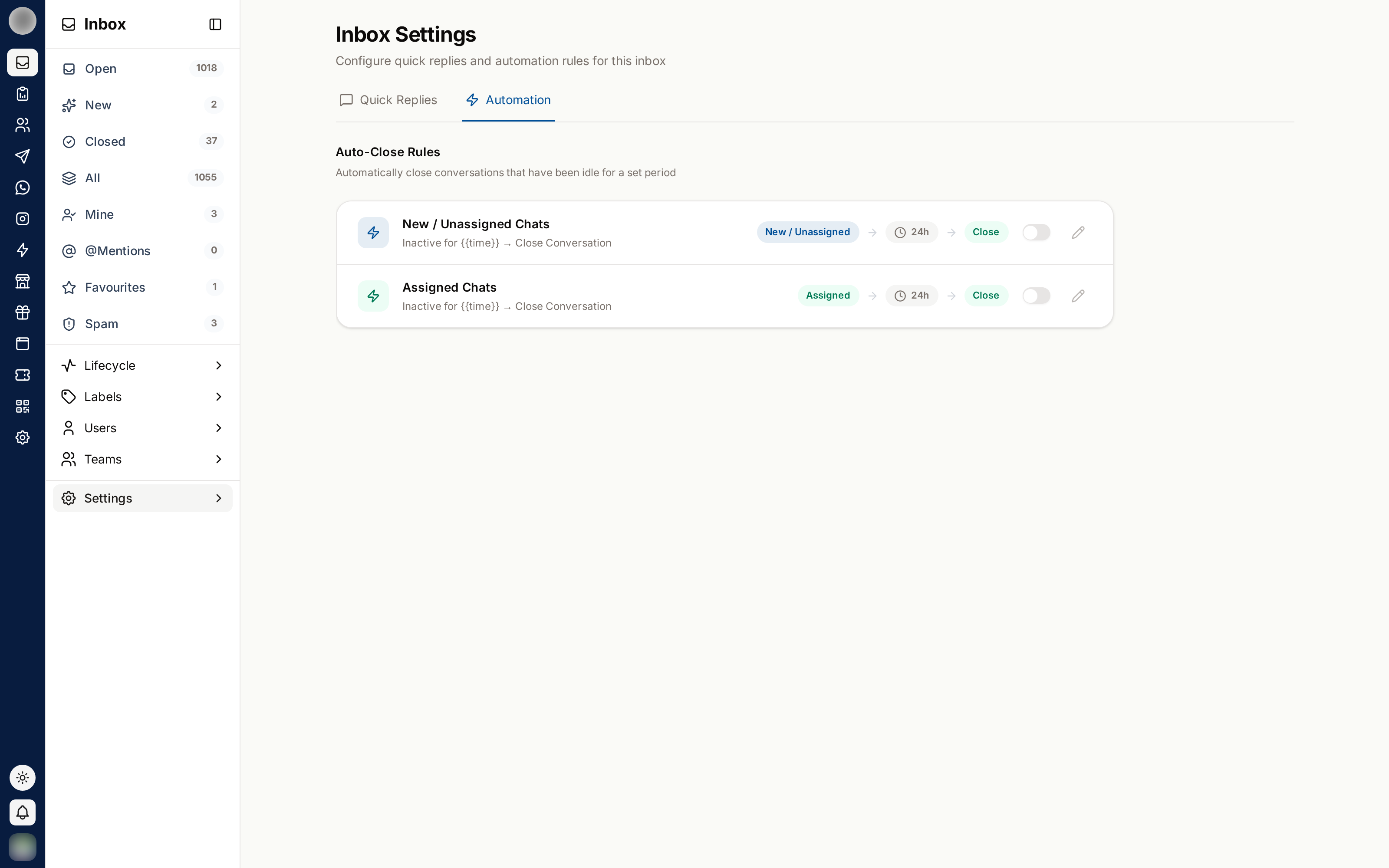
There are two rules, each switched on or off independently:
| Rule | Applies to |
|---|---|
| New / Unassigned Chats | Tickets nobody has taken |
| Assigned Chats | Tickets with an owner that have gone quiet |
Each reads: inactive for <time> → Close Conversation.
Edit a rule
Open the Automation tab and click the rule you want to change.
Confirm the chat type — New / Unassigned, or Assigned.
Pick a close after inactivity period from the presets, or choose Custom and enter a number of hours.
The action is Close Conversation — the thread is marked closed and agents can reopen it at any time.
Save.
Choosing sensible periods
| Rule | Typical | Why |
|---|---|---|
| New / Unassigned | Shorter — 24–48 hours | If nobody claimed it in two days, nobody will |
| Assigned | Longer — 72 hours or more | An owner may legitimately be waiting on the customer |
Set the assigned-chat period too short and you will close tickets agents are still working on. Start generous and tighten it once you have seen the effect.
Auto-closed tickets behave exactly like manually closed ones: read-only, no assignees, and reopenable. If a customer writes again, a new ticket is created.
Related Pages
- Replying to Customers — where quick replies are used
- Closing & Reopening — what closing does
- Conversation Tags — tags and labels, and how they differ
- Accessing the Inbox — roles and permissions